While some of you are busy worrying about other people touching and playing with your hair, I am worrying about myself. I keep touching, playing, fumbling and twisting my hair! I need to stop this because after on-going tension it just breaks off. This has happened so many times. I do it subconciously, maybe when I am bored or on my laptop. But it needs to stop before it turns into a habit and I have no edges left to play with. Yes, you read it right. my edges! my edges!
You know about my edges. Fragile? Yes. But my fingers can reach.
I need help.
Current hair goal: KEEP MY HANDS OUT OF MY HAIR.
It's good to start building healthy habits earlier on in your regimen.

Showing posts with label tips. Show all posts
Showing posts with label tips. Show all posts
29 Mar 2014

27 Oct 2013
Edges Care
My edges have been very thin and I think it's time for me to start paying special attention to it. I was initially put off from doing another protective twists/braids again because of the damage they would do to my edges. It would take a month for my edges to renew themselves again and I told myself, I would never do single twists again. My edges!!!
But, I decided to search online for ways to protect the edges, especially when doing protective styles. Your edges are the most vulnerable tresses.
Through the web of information, one routine managed to catch my eye which was: moisturise your edges!
Seriously, do we actually do this? When we read 'moisturise your hair' we forget the most vulnerable and driest tresses which are our edges. So, I've prioritised spraying my edges with water daily and moisturising them. I used to only oil them (castor oil+peppermint oil) but never would I think to moisturise them. Since I've began doing this, I've noticed the growth in my edges, they are actually starting to restore themselves! This will definitely continue because I want my edges to grow full-out.
Anyways here are some tips to keep your edges healthy (for those who don't have full edges like Beyonce, but thinning edges):
But, I decided to search online for ways to protect the edges, especially when doing protective styles. Your edges are the most vulnerable tresses.
Through the web of information, one routine managed to catch my eye which was: moisturise your edges!
Seriously, do we actually do this? When we read 'moisturise your hair' we forget the most vulnerable and driest tresses which are our edges. So, I've prioritised spraying my edges with water daily and moisturising them. I used to only oil them (castor oil+peppermint oil) but never would I think to moisturise them. Since I've began doing this, I've noticed the growth in my edges, they are actually starting to restore themselves! This will definitely continue because I want my edges to grow full-out.
Anyways here are some tips to keep your edges healthy (for those who don't have full edges like Beyonce, but thinning edges):
- Spray and moisturise your edges daily! This makes it pliable and less prone to breakage. Remember, your edges are still part of your hair. Use a tiny spray bottle (£.99p) filled with water, leave-in conditioner and an oil.
- Moisturise with castor oil and peppermint oil. Castor oil helps to thicken the hair and peppermint oil helps to stimulate the blood flow. Perfect combo.
- In single twists/braids: make sure that the parts are cut a bit bigger at the front (no to tiny twists/braids), braid loosely at the front (not to loose since you want that tight face) to release the tension - this will ensure that the hair can move in all directions, extremely tight braids can damage the follicle and lead to hair loss, also, when packing up your hair loosen up the braids at the front to reduce the pull and avoid the risk of traction alopecia.
- Some people's scalp line are more sensitive than others. Determine how sensitive yours is.
22 Jan 2013

15 Jan 2013
The best places to get natural hair inspiration from?
http://blacknaturals.tumblr.com/


http://thenaturalchica.tumblr.com/ - < this woman wow!
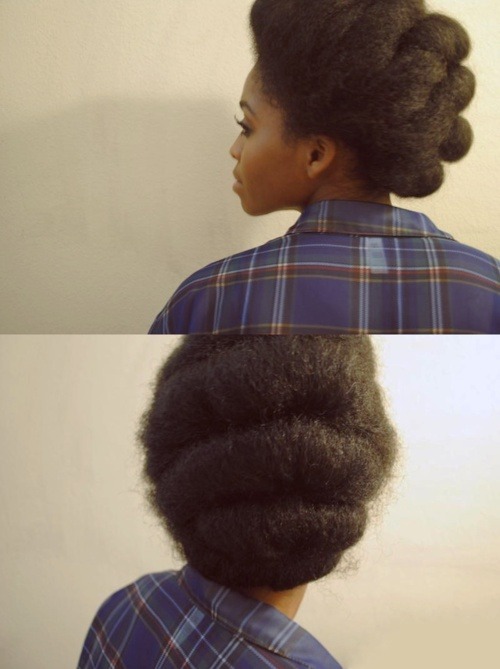
If I want to be motivated to do something, I want to be inspired. I want to see how, and that others have done it, and so can I. :D Pictures!!
I can't wait to add some colours to my curls.

6 Jan 2013
How to: Garlic and Onion treatment
''Garlic is not just good for our body, but also for our hair. Garlic extract can get rid of and destroy dangerous toxins and stimulate blood circulation, essential in the scalp for proper hair care and growth and avoid hair loss.
Onion (Allium cepa) recognised with healing qualities incorporate their antibacterial, cleansing, stimulating, and nourishing powers. Onions contain a number of important minerals and vitamins, such as vitamins C and B6, calcium, magnesium, potassium, and germanium. Onion also has a high sulfur content. Sulphur is a mineral present in every cell in our body, with its greatest concentration in hair, skin and nails. It has typically been referred to as the “beauty mineral” and the “healing mineral” simply because of its ability to promote circulation and reduce inflammation. These qualities also lend to the theory that adequate amounts of sulphur can jump-begin hair growth in individuals with deficiencies. High amounts of sulphur in onions make them particularly powerful in regenerating hair follicles and stimulating hair regrowth. In addition, naturally-concentrated sulphur compounds have been confirmed to show additional hair-restoring.
-----------------------
One of my main hair goals included growth of my edges, my temple and nape. I researched on methods to tackle hair loss and I stumbled upon these natural treatments - onion and garlic. I tried something. For just 3 days I rubbed on a mixture of grated onions and garlic with olive oil and I had began to notice growth! I stayed away from castor oil because I wanted to see how much it would grow without the great castor oil. Well, the result was amazing! Garlic and onion treatments are not common, having searched through youtube hair tutorials however I found some videos and the girls all said they experienced hair thickness! Now, my main goal for this hair is to achieve thickness so I had found a way to incorporate this treatment into my regimen. Who knew onions and garlic could be so beneficial to hair! So, I tried out what this girl did (today, and I shall let you know how it goes throughout the year):
[Someone asked on the comments of this video if it truly worked and she replied that she had to stop one time because her hair began to get too thick (as if that's a problem!).. I think I went mad for a bit! I HAD to try this and I shall continue to.]
I shall be doing this treatment every two weeks (added to my hair track duties list). Exactly what she did. So thanks to her!
How you do it: just slice up half an onion + 2 garlic cloves and boil them with a cup of water (tiny spray bottle size) till the onions become see-through and garlic turns white. Let water cool down a bit, take out the vegetables with your spoon (warmth is good) and pour into a spray bottle. Spray it generously through your hair, letting it soak into scalp and hair. Put on a shower cap and leave it for 1 hour. Make sure you cover your shoulders with an old towel and clip it on tight to the neck as the onion water may drip down. The smell did not affect me, if any. Wash hair and condition as usual.
Benefits experienced:
- increased thickness
- reduced shedding
- shiny and stronger hair
DON'T UNDERESTIMATE THE POWER OF ONIONS!
31 Dec 2012
Some hair science for you!
Effect of mineral oil, sunflower oil, and coconut oil on prevention of hair damage.
Rele AS, Mohile RB.Source
Research and Development Department, Nature Care Division, Marico Industries Ltd., Mumbai, India.
Previously published results showed that both in vitro and in vivo coconut oil (CNO) treatments prevented combing damage of various hair types. Using the same methodology, an attempt was made to study the properties of mineral oil and sunflower oil on hair. Mineral oil (MO) was selected because it is extensively used in hair oil formulations in India, because it is non-greasy in nature, and because it is cheaper than vegetable oils like coconut and sunflower oils. The study was extended to sunflower oil (SFO) because it is the second most utilized base oil in the hair oil industry on account of its non-freezing property and its odorlessness at ambient temperature. As the aim was to cover different treatments, and the effect of these treatments on various hair types using the above oils, the number of experiments to be conducted was a very high number and a technique termed as the Taguchi Design of Experimentation was used. The findings clearly indicate the strong impact that coconut oil application has to hair as compared to application of both sunflower and mineral oils. Among three oils, coconut oil was the only oil found to reduce the protein loss remarkably for both undamaged and damaged hair when used as a pre-wash and post-wash grooming product. Both sunflower and mineral oils do not help at all in reducing the protein loss from hair. This difference in results could arise from the composition of each of these oils. Coconut oil, being a triglyceride of lauric acid (principal fatty acid), has a high affinity for hair proteins and, because of its low molecular weight and straight linear chain, is able to penetrate inside the hair shaft. Mineral oil, being a hydrocarbon, has no affinity for proteins and therefore is not able to penetrate and yield better results. In the case of sunflower oil, although it is a triglyceride of linoleic acid, because of its bulky structure due to the presence of double bonds, it does not penetrate the fiber, consequently resulting in no favorable impact on protein loss.
I was researching whether sunflower oil was good for the hair and I stumbled upon this. Pretty interesting! It made me glad that coconut oil is my sealant.
17 Dec 2012
Book to buy: The Science of Black Hair *IMPORTANT HAIR EDUCATION*
See, many of us have carried out various online researches ranging from blogs to vlogs and youtube channels etc. However, it is important to be able to have a nearby source of information that is portable. One that you can look for whenever you're in need of a quick reference or advice. Well, The Science of Black hair is a good one. I've read reviews and ofcourse, my Lisa told me about it and I really want to read it! I shall buy it one day! It is equipped with so much information that will be essential throughout your journey or if you are at the start of one or considering beginning one. I am excited! If you want to know the basics about healthy hair care, check out the links below!
Click here for the details on Amazon

Click here for the details on Amazon

I checked out the authors website! Some really useful basic information is on there which I shall read now:
14 Dec 2012
There are only so many products you can use on your hair
I mean, I have been watching many videos of products used by girls with long hair. It made me realise, not every product will suit every hair so its best just to choose a certain or set of hair products, try, change and adjust. Keep your product list to the minimum, as well as the ingredient list. There are sooo many hair care products, but if you do your research well, you will have a good eye for the right ones. Ofcourse, regardless of research, your hair needs have to be taken into consideration as well. Balancing the two is crucial and knowing how much is too much is essential. As you can see, I have used many products, learned from my research and from my personal journey and have in return, made the appropriate changes.
What I really want to set out during my hair journey is being able to remain minimal, with little hassle or expense and still being able to grow long health hair.
Lessons.
What I really want to set out during my hair journey is being able to remain minimal, with little hassle or expense and still being able to grow long health hair.
Lessons.
7 Dec 2012
Single Braids Tips! #3
If your hair has been recently chemically processed, avoid putting in braid/weave/cornrow extensions for a least a month. By then you will have some new growth to fortify the chemically treated hair, which is by nature weaker and porous, stronger more resilient hair for braid/weave/cornrow extension to be attached to.
Make sure your hair is in good condition before embarking on putting on braid/weave/cornrow extensions. If hair is weak, brittle, breaking and experiencing excessive shedding, the braid/weave/cornrow extensions will only exacerbate the situation. We tend to see braid/weave/cornrow extensions as a way of masking or covering hair issues, so we look presentable till the issue is resolved. This is not the case, the weight and mechanical tension of the braids will only put more traumas on the hair. If there is a hair condition that is too bad to have out in public, it is better to try wigs as these can be removed every evening and the hair treated with whatever is needed, and also there is not pressure or tension applied to the hair to wear a the wig. DO NOT use glue on wigs though!
Do not apply braid/weave/cornrow extensions that are too heavy for your hair, the rule of thumb should be that the hair to be applied should be about the same amount in thickness as the hair it is to be attached to, that is to say if you section out a pencil sized amount of your hair, then your will attach hair of a pencil size in thickness to it. Also try to make the length of the extension no more than two and a half times the length of your own hair. If you want to make the length longer, then the thickness of the attached hair should be less than the thickness of the section of hair you want to attach it to, (but keep in mind though that if your hair is naturally curly or kinky and in its natural curly or kinky state, this will start to look untidy after your first wash). The reason for being careful of the size and length of the hair you attach to your hair is rather simple; you do not want to put undue strain on your hair and hair follicles, by adding too much weight for the hair to bear. This will lead to breakage, shedding and Alopecia.
Do not make the braid/weave/cornrow too tight. You do not want to sacrifice the health of your hair for style. If the braid/weave/cornrow extensions are too tight, you could end up with tension alopecia. Trichologists claim that when this type of alopecia happens to the edges and nape it is possible with perseverance to grow the hair back, but if it happens in the centre of your head this hair will never grow back. Make sure you insist to your stylist that you do not want the braids too tight.
Before braiding prepare the hair for the application of the extensions. Fortify, strengthen and build up your strands with a deep conditioning protein treatment (leave on hair for at least 20 – 30 minutes under a steamer or heat cap, or an hour if using a shower cap, towel and body heat). Follow this with a deeply moisturising conditioner, (again leave on for the prescribed times mentioned for the protein deep conditioning), one that compromises of Shea Butter and Coconut, is a good one to go with. Shea Butter for its moisturising properties and ability to seal in moisture, and Coconut Oil for its ability to moisturise hair strands and transport protein into the hair shaft.
When wearing your braids, wash your hair regularly, alternating between a light silicone free conditioner – co washing one week, and a sulphate free shampoo wash the next. This will prevent build up that can cause the hair to matt which will lead to tangles and hair breakage when you take out your braids. The best way to do this is to dilute the shampoo with water about 2 parts shampoo to one part water and put it in an applicator bottle. Wet hair thoroughly and apply the diluted shampoo to your scalp, use your finger pads to massage in gently and work into a lather, then rinse. During the rinsing the soapy water will work its way down the length of the braid and carry any dirt and oil with it.
Deep condition your hair after every shampoo wash to replace oils removed. You can use a shorter lighter conditioner treatment for after a co wash.
Seal in moisture after conditioning with a good water based moisturiser (this is moisturiser that has water as its first or one of its main ingredients).
Wrap hair in a turban with a micro fibre towel or cotton tee shirt, then when hair is no longer dripping allow it to air dry.
Oil your scalp once a week after every wash to prevent dry scalp and flakes forming. You don’t want dandruff whispering your secrets everywhere you go!
Moisturise your hair daily by misting with water, or an oil and water mix. Make sure you mist the roots as well as the entire length of your own hair with in the braid/weave/cornrow extension.
Apply a heavy moisturising butter like a Shea Butter and Coconut mix every other day after misting.
Do not carry your braids for too long, as tempting as it may be, especially when you think of the time and money spent to do them! The longer your leave the braids in the more likely you will get build-up and matting of your hair of some sort which will lead to hair loss and breakage ultimately.
When you take out your braids, remember to repeat the protein treatment, then moisturising treatment previously mentioned.
- curly2kinky
Single Braids Tips! #2
People tend to think that the moment they put braids extensions in their hair . It will automatically grow
their hair and they don't have to do any thing else. Truth is, this is the best time to take care of your hair
naturally and still wear extensions. It's pointless to wear braids for 3 months only to realize that the
situation and condition of your hair is more or less the same if not worst, especially if the motive for
braiding is to improve the overall well being of your hair and to take a break from all forms of hair
chemicals. I suggest the following steps to a healthy braids wearing and to achieve
happiness/satisfaction once the braids are out.
1: Chemicals - Avoid applying Individual extensions/braids in your hair at least until after 2 weeks of an chemical input. Sometimes braiders will tell you that relaxing your hair just before braiding will make your braids neater and more presentable. Truth is the neatness of your braids depends on how good the
braider is at parting the hair and more often than not, the length of your own hair. Very short hair tend to
come out of braids whilst longer hair stay put.
2 : Before braiding - Deep condition your hair a day before applying the extensions. Continue to deep
condition your hair even when you have the braids in at least once in 2 weeks . I suggest you use a
conditioner that is rich in protein. Use an equal proportion of shea butter and coconut oil as deep
conditioner. (I have these products available too). If your hair is strong, though/hard I suggest you stick to
the same regimen as mine. I have vowed never to do without these two ingredients in my beauty regimen
and that includes my body/skin I am staying strictly to shea butter because of it's moisturizing properties.
Deep condition your hair for about 1 hour ( i normally stay longer, I deep condition when I have no where
to go so there's no hurry). Concentrates more on the root/scalp of the braids than the body it self. Always
remember that if the foundation is weak the building will collapse .
3: Washing/shampooing - Wash your braids once in 2 weeks. This is very good for your hair as it allows
your hair to rest from the chemical contents in shampoos even though some shampoo products say they
have little chemical contents, my advice is, it's better to be safe than sorry. Washing your braids every
two weeks will allow the braids to retain it's strength and reduce early rough appearance. I must say that
braids is one of the very few hair styles that even when it's rough it's still beautiful. Buy a cheap old
shampoo if you must as braid extensions gulp lots of it before it lathers.
4: Coconut oil usage as hair nutrient dates back as far as the beginning of the black race in Ile-ife( the
origin of black nation). Coconut oil helps softens yet strengthen and promotes your under growth. It also
promotes hair growth. Coconut oil is as strong and solid as coconut itself. An African proverb goes thus
" Any one who breaks a coconut with his/her head will not be among the people that will eat it " That
adage is to show the extent of the power of coconut, so imaging something as strong as that fighting for
the benefit of your hair. The result is total success.
Another great ingredient to have at hand during your braiding period is unrefined Shea Butter ( Coconut
oil and shea butter are now available on our African Body Products page). This is the master of moisture
and healthy groom. There are many fake shea butter out there, please beware. Never use refined shea
butter, it's been chemically process. The Original Shea butter is cream in color and as often as many
beauticians try to tell people that shea butter can come in many shades. It doesn't. I spent 27 yrs in West
Africa and shea butter is a must have house old item over there. I grew up with shea butter and the color
has never been other than cream . The color is Cream. The smell cannot be explained, it's close to
being odorless, yet it's not. It's not offensive at all. shea butter is all purpose moisturizer. Your skin will
thank you and your hair will rejoice. If you don't have coconut oil or shea butter use braid sprays such as
African pride instead but get your hands on one of the ingredients above as soon as you can. Always oil
your scalp at least 3 times a week to retain moisture and prevent flaky scalps or dandruffs.
- hadjabraids
Single Braid Tips! #1
While your hair is Braided
Be sure to Moisturize:When hair is in braids, it often loses its moisture, making it easier to fall out. To help seal in moisture, remember to spritz hair with store bought braid sprays or a concoction of you own.
- You can create your own mixture by mixing oils like Jojoba, Olive, with water and glycerin.
Pay attention to braid BUILD-UP and NEW Growth
This usually happens when you have used too much product and your hair knots up at the roots after the emergence of new growth. At the site of build-up, simply take out old braids and re-braid, doing so often ensures your braid is always looking fresh
Remember to Wash
Just because your hair is in braids does not mean you should stop washing it. One easy way to wash your hair and maintain the style is to wash it with diluted shampoo while in the shower. Massage your scalp to release the debris, move along to the rest of your hair, and be careful not to tug on your hair too much. Don’t forget to condition your hair after washing, this can be achieved with the help of a leave-in conditioner.
Be sure to wash your braids once in two weeks, pay particular attention to the scalp.
Cover your braids before you sleep:
Whether it is a hair net or silk scarf, it is important to protect your braids from loosening while you sleep by covering it.
- bellanaija
22 Aug 2012
Subscribe to:
Posts (Atom)